unitedenergyhub

100% Australian owned & operated

Sydney · Melbourne · Brisbane · Adelaide

SA Lic. BLD 344519 · NSW Lic. 480314C

News.

News.

How a battery storage project moves from design to energisation

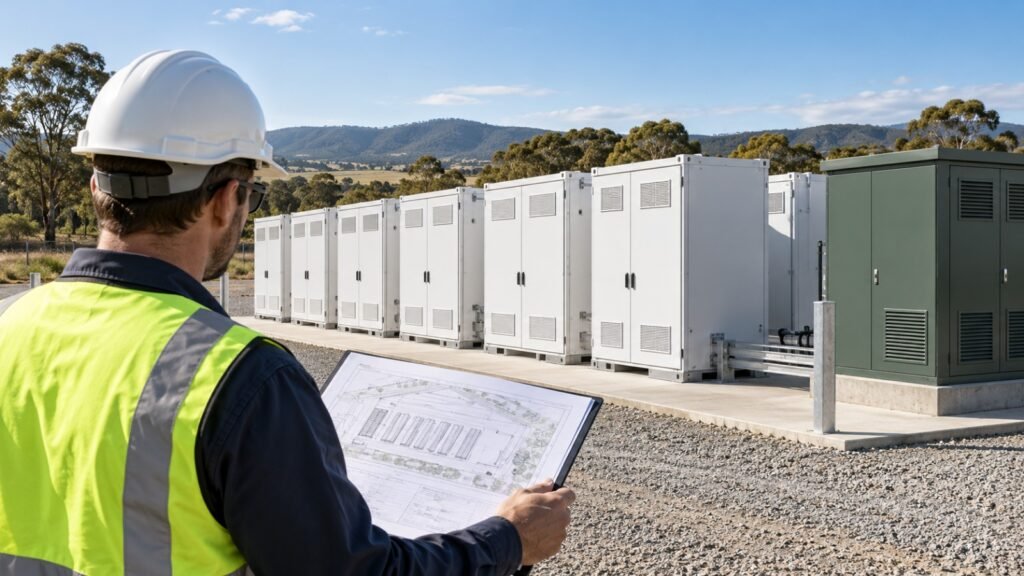
How a battery storage project moves from design to energisation Good battery projects start with a clear operating purpose and a coordinated delivery plan. Here is what happens between assessment and energisation. The first question in a battery project is what the system needs to achieve. A business may want to use more of its solar generation or manage peak demand. A grid-scale project may be designed around market participation and network constraints. Those objectives shape the equipment and delivery plan. Assess the site and connection For a business, electricity bills and interval data help establish the load profile and potential savings. Site access, available space, existing electrical infrastructure and planning requirements are assessed alongside the network connection pathway. For a utility-scale project, land, connection capacity and the proposed operating model are central to feasibility. Identifying constraints early helps avoid designing a system around an unavailable connection or unsuitable site. Develop the design and delivery scope Engineering brings together the battery, inverter or power conversion system, protection, controls and civil design. The project team coordinates the relevant approvals and agrees who supplies equipment, completes specialist studies and carries out testing. Procurement and construction planning then follow the approved design. Equipment lead times, foundation readiness and access for deliveries all affect the programme. Build and test the installation Construction typically includes foundations, trenching, equipment placement, cabling and electrical installation. Inspection and testing verify the work before the project moves through the required energisation and commissioning steps. The test plan needs to address both individual equipment and the interfaces between suppliers. Network permissions, protection settings and control communications must be coordinated with the relevant parties. Prepare for operation Handover should include the agreed drawings, test records, manuals, warranty information and operator training. Monitoring and maintenance responsibilities need to be clear. Backup power, where required, must be designed into the system; battery storage alone does not establish an outage supply. UEH brings engineering and construction experience from commercial and utility-scale projects, including Naracoorte’s 33 kV connection. We work with owners to define the scope and delivery responsibilities before construction begins.Talk to UEH about a battery project


News.

Preparing batteries and inverters for CEC product listing

Preparing batteries and inverters for CEC product listing A complete technical file helps manufacturers avoid preventable listing delays. UEH supports battery and inverter applications for the Australian market. Manufacturers bringing batteries and inverters to Australia need a clear product compliance pathway. Where a Clean Energy Council listing is required, the application must match the product being supplied and include the necessary technical evidence. UEH helps manufacturers review that evidence, identify gaps and prepare an application. We support the technical process; the CEC makes the listing decision. Begin with the product configuration The first step is to define the models and configurations covered by the application. Product names, ratings and supporting documents need to be consistent so the assessor can identify exactly what is proposed for listing. UEH reviews the available test reports, certificates, labels, manuals and technical files. Missing evidence or conflicting information can then be addressed before submission, with laboratories and certification bodies involved where further work is required. Support through the application Our role can include a document gap assessment, advice on the applicable listing pathway, preparation of the technical package and coordination of assessor queries. Manufacturers remain responsible for providing accurate product information and completing any required testing or corrections. For energy storage products, we can also review the documentation interfaces between the battery, power conversion equipment, battery management system and energy management system. This does not mean every component has its own standalone CEC listing category. Allow time for assessment Listing schedules depend on product readiness, test availability, application completeness and the CEC’s workload. Manufacturers should check current processing times before setting launch dates. UEH cannot guarantee approval or a fixed completion date. CEC listing is also distinct from project-specific network approval, installation compliance and incentive eligibility. Those requirements need to be checked separately for the intended use. Send UEH your model list, technical specifications and available certification documents to start a readiness review. Explore our CEC listing support  |  Discuss your product Further information: CEC application process and current processing times

News.

Connecting battery products to Australian virtual power plants

Connecting battery products to Australian virtual power plants Reliable VPP participation starts with a tested connection between hardware and software. UEH supports manufacturers through integration and deployment. A battery can respond to a virtual power plant only when its hardware, communications and control software work together. For manufacturers entering Australia, that connection needs testing on real equipment before it is deployed across customer sites. United Energy Hub supports battery and inverter manufacturers, distributors and energy retailers with VPP integration. Our work covers API integration, hardware testing and technical coordination for deployment. Turning an API into a working connection An application programming interface, or API, lets systems exchange information and commands. Integration involves mapping the product’s available data and controls to the VPP platform, including operating limits and the information needed to monitor the battery. Hardware testing then checks how the equipment responds. The aim is to identify communication gaps, unexpected behaviour and compatibility issues while engineers can still investigate and correct them. Preparing for deployment UEH works with manufacturers and retail partners, including Covau, to coordinate the path from testing to deployment. The agreed scope can include technical documentation, test results and support for resolving issues during rollout. Compatibility is confirmed for the specific product model, firmware and platform configuration. A completed integration for one model does not automatically cover every product sold under the same brand. What battery owners should expect A VPP can coordinate participating batteries in response to electricity prices or grid needs. The value to an owner depends on the retailer’s offer, tariffs, dispatch rules, battery use and any participation fees. These commercial arrangements should be assessed alongside the technical integration. If you are preparing a product for the Australian market, share your API documentation, product specifications and available test hardware with UEH. We can review readiness and agree the integration scope, testing plan and expected timing. Learn about UEH VPP integration  |  Contact our integration team

News.

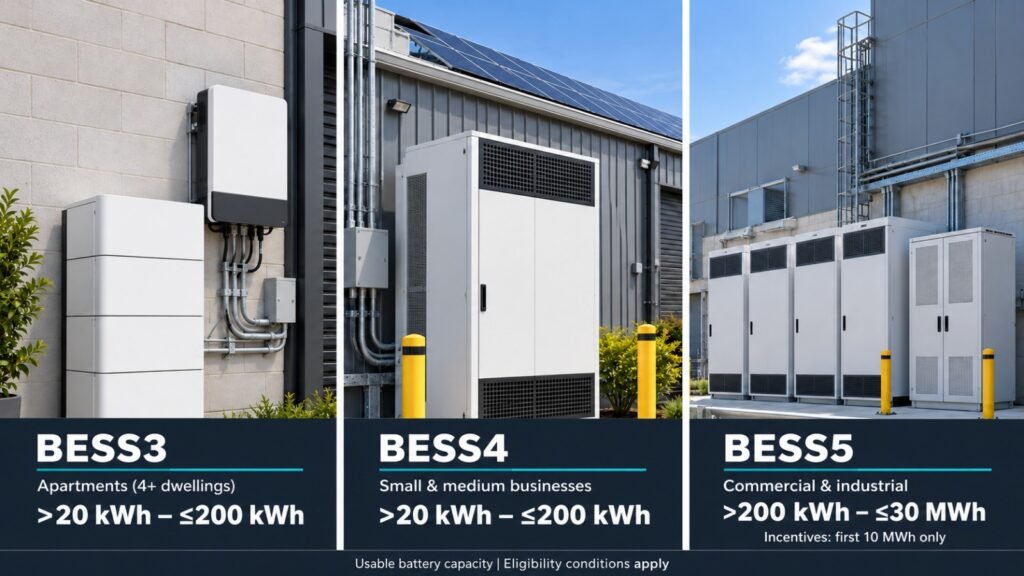
Choosing between NSW BESS3 BESS4 and BESS5

Choosing between NSW BESS3 BESS4 and BESS5 Building type and usable battery capacity determine which NSW incentive pathway to assess. Compare the three activities before choosing a system. NSW’s Peak Demand Reduction Scheme has separate battery installation activities for apartment buildings and businesses. Choosing the right pathway starts with the building and its electricity needs. Activity Intended site Usable battery capacity BESS3 Eligible apartment buildings with at least four dwellings More than 20 kWh to 200 kWh BESS4 Eligible small and medium business installations More than 20 kWh to 200 kWh BESS5 Eligible commercial and industrial installations More than 200 kWh to 30 MWh BESS3 for apartment buildings BESS3 supports a shared battery serving common property loads, multiple dwellings or both. The battery must be installed outdoors, and strata approvals, metering and the way benefits are shared need attention before installation. A minimum purchaser payment of $1,000 excluding GST applies per implementation. BESS4 for businesses BESS4 can suit businesses such as medical centres, warehouses and hospitality venues. It requires a minimum purchaser payment of $5,000 excluding GST per implementation. Residential buildings and data centres are excluded, and eligible products and installers must be used. BESS5 for larger installations BESS5 covers larger batteries installed behind the meter. Its incentive calculation is capped at the first 10 MWh and is also limited by inverter output. The battery must meet the specified UL9540A testing and performance requirements. Unlike BESS3 and BESS4, BESS5 has no scheme minimum purchaser payment. Compare the design as well as the discount The capacity bands refer to usable capacity recognised under the scheme, which may differ from a product’s advertised nominal capacity. Inverter output, approvals and control capability also affect eligibility. A site cannot receive successive BESS4 and BESS5 implementations. New solar is not compulsory for every eligible project. Qualifying new or additional solar installed within 90 days of the battery can increase the incentive, subject to the activity’s conditions. The system should still be sized around energy use, site limits and the intended operating strategy. UEH can assess your site and coordinate the technical and incentive checks with an Accredited Certificate Provider before you commit. Discuss your NSW battery project Scheme information checked on 23 October 2026. Final eligibility and discounts require project-specific assessment. Further information: NSW Government apartment battery guidance | NSW Government business battery guidance | IPART activity requirements and Rule changes | Current PDRS Rule

Scroll to Top